This post touches on life and videogames, and is a kind of mild rant, which means it sort of covers all three of my blog's subheadings. Excellent.
This post will also be a break in the Memoires series. Think of it as that quiet moment of reflection in a war movie, where all the gunfire fades out and the reflective music is turned up to 11, and the main character looks at the faces of his dead comrades and asks himself (or herself, lets not be sexist here): what is it all for?
All that time, effectively spent jacked-in to the matrix of Azeroth. What was it all for?
No doubt by now, if you've been reading this series of posts, you will hopefully have realised that MMORPGs hold in themselves complicated challenges and lend themselves to the construction of completely new social structures as well as allowing people to connect in completely new ways.
You may also have thought that the whole thing was pointless, especially if you weren't a gamer (although I have my doubts that anyone who has read this far falls into this category). Be that as it may, I hope the following discourse will still provide fresh food for thought.
To answer the question of "What is it all for?" I think it's best to start from the basics.
What are video games? How do we classify them? I think the clue is in the title - they fall under the category of "game" along with such things like Chess and Backgammon (which I have no idea how to play). This differs however from what I perceive to be general perception of the video game; that it is a form of mindless entertainment like watching the TV, where one consumes content but does not interact with it (or even in some cases, create it). Of course, it's a bit of a sliding scale as far as video games are concerned, as some games are quite mindless whereas others require ample amounts of mental dexterity and lateral thinking.
By extension then, this means that the popular perception of the gamer as a media consumer is fundamentally flawed. Video gaming is actually a hobby, like pursuing a craft such as writing or depending on the game, even a sport. If we look at video gaming from this light, then it's easy to see why people get passionate about it, notwithstanding the fact that games are inherently designed to dole out certain rewards for the work which a gamer puts in.
Right, let's go back to our initial question: What is it all for? Why do people write? Why do people play games?
If we ask this in the context of say, creative writing, a multitude of answers can arise: some people will write because for them it's a release and an escape from the stress of daily life. Others will write because they want to show their skills to the world, and they want to be appreciated for their work and others still write because for them it's how they can study the world and the people around them.
The same applies to video games. For some it is again, an escape. Others play to showcase their skills and to win (for example, there is a growing professional eSports scene surrounding games like Starcraft 2, which is also incidently a fun spectator sport). Finally, and most excitingly to me, social games allow people from all different creeds and classes to connect and be on equal footings, which broadens the horizons of all involved, and they also allow a unique and valuable view of various aspects of the human condition which are difficult to study in real life.
So, what is it all for, for me? Well, at first, playing World of Warcraft was my way to get away from the boredom that was life outside school. It turned into something different altogether; it became my way to prove myself - to try and find meaning in my teenaged existence, it became a way to satisfy my competitive urges and it also turned into a surprisingly good social experience too. Amongst that online space in a world where slaying dragons was the norm, I found somewhere where I really felt accepted and appreciated, somewhere which taught me how to lead and manage a diverse range of people, somewhere where I made long lasting friendships, and somewhere where I experienced visceral highs and crushing lows, all wrapped up in one neat little package for £8 a month.
Funnily enough, Badminton fills most of these criterion too, and that's been another activity that has been a staple of my life for as long as I can remember. However, if I spent hours a day training Badminton, it could easily be considered a noble pursuit. If I spent those same hours researching and theorising about how to maximise the healing potential of my priest, well...you get where I'm going with this.
This is the one thing that frustrates me a lot; the perceived lack of "validity" of video gaming as a pursuit. By this I mean that even though I don't have any interest in something like Major League Baseball, I recognise that it takes skill, dedication and talent to play well and to rise to the top. On the contrary, when a video gamer achieves something, the common reaction of joe public is to go: Good for you, but it's only a videogame - it doesn't matter!
It's a viewpoint that's sold readily by the media and along with all the other stereotyping that's applied, has pinned a very negative stigma on people who play games. This of course, isn't helped by the fact that "video games" is an umbrella term which covers all sorts, from simple puzzle games like Tetris to an extremely complicated game like Civilization IV - a strategy game where the objective is to build a civilization and dominate the world. To use the writing analogy, the difference between the two games is like the difference between a haiku and a full blown fantasy epic: you can of course find meaning in both, but the fantasy epic is more complex, deeper and one would expect the more satisfying read.
If you're good at Tetris, well, you're good at Tetris. If you're good at Civ IV, it shows sound strategic thinking, resource management and tactical thinking, it shows that you are good at balancing competing demands and are able to prioritise as needed - in short, it shows you are able to perform well at a lot of high level cognition tasks; the sort of thing which is valued in pretty much any job.
According to Google, one can define a "game" as a form of play or sport, esp. a competitive one played according to rules and decided by skill, strength, or luck. Using this definition, we can say that there is fundamentally no difference between Starcraft 2 and Football, and the two are only perceived differently by society and given different weights of importance and validity accordingly.
In a way, even passing exams and getting a degree is a game: the examinee is trying to maximise points scoring by providing answers which conform to an arbitrarily chosen set of criteria. You could argue that the importance of getting a degree comes about since it relates directly to your earning potential, however, given that there are now monthly Starcraft 2 tournaments that pay out $100000 in prize money and there is a growing market in the sale of virtal items and money for real world cash, it should no longer be considered strange that one can make a living from video games. But anyway, I digress.
The point I'm trying to make is: so much of what we do in life is actually just playing games. These games go under various pseudonyms such as exams, job interviews and climbing the career ladder and so are artfully disguised by the cloak of cultural norms, but they are still games nonetheless. It seems odd then, that when we play games that are labelled as games, society as a whole is all too ready to look down on it.
12 July 2011


8 July 2011
Memoires (Part 11 - Skill, Motivation and the Blackwing Lair)
I don't know what it is about epic stuff that appeals to me so much, but I just can't get enough of it. Give me shining heroes and evil villains, two armies clashing, armour and swords gleaming, set to a stunning epic orchestral soundtrack and I will be a very happy man.
Actually, the visuals aren't even necessary; play an epic soundtrack to me and I'll daydream the rest of it.
Anyway, at this point in my World of Warcraft career, it sort of felt like I was writing my own fantasy epic, along with the rest of T3M. We were gearing up to take on Blackwing Lair, the next raid dungeon which had been released by Blizzard. It was home to Nefarian (Onyxia's older brother) and his evil minions. They were determined, as evil villains of this sort usually are, to take over the world, and of course, our role as the do-good heroes of Azeroth was to stop them.
We had a little bit of downtime after Ragnaros was killed to bathe in the afterglow of our victory, but then began on working getting everyone entrance into the lair, which involved a short quest in one of the lower level 60 dungeons. Within the week, we had everyone attuned and raring to go.
We charged headlong into the lair, and straight into the brick wall that was the first boss: Razogore the Untamed. Entering the lair was quite different from our first attempts on Molten Core, given that due to the newness of the dungeon there was no widespread information regarding fight tactics. The purist gamer in me was somehow quite pleased about this, and such was my standing within T3M that I managed to convince most of the raid that it would be a good idea to figure it all out on our own anyway, because that's what real gamers do!
As it so happened, Razorgore was the most complicated encounter to date tactically speaking. Whereas with previous bosses it would have been fairly easy to work out that one had to avoid the massive clumps of fire, dispel the curses and then kill the adds even had we not known the tactics, Phase 1 of Razorgore was a completely different encounter, which can best be described as controlled chaos.
Basically, succesfully completing the encounter involved having the Hunters run around the room being chased by dragons, the Warriors run around the room being chased by orc warriors, the Rogues and Mages run around the room killing orc mages and everyone else standing around the corners of the room, with their own little things to do. Apart from Priests, who were a little bit useless in the first Phase as our heals generated too much threat. For us, it was essentially a little bit like a cartoon, where as a Priest we stood in our allotted corner of the room, behaving nicely and every so often a warrior would run by (I imagine screaming his or her head off), followed a few seconds later by a throng of stampeding orcs waving their massive swords angrily (and probably also screaming their heads off). Then, every once in a while a Hunter would run by, huffing and puffing, with a small dragon hot on his or her heels. Meanwhile, one member of the raid had to mind control Razorgore (a medium sized dragon) and run around the room destroying eggs. Once all the eggs are destroyed, Phase 1 ends. After which, Phase 2 was fairly straightforward.
 |
| Run, dwarf, run! |
 |
| Rogue kill mage. Razergore kill egg. |
It was a bit of a shame that the tactics were so obscure, as my opinion on it now is that it was actually a really fun encounter which tested the skill of every player in the raid.
I know I've mentioned skill several times through the course of these Memoires, and you'll probably be scratching your head trying to define what skill actually means in the context of this game. In First Person Shooters, it's fairly obvious; reactions and accuracy, however, in the raiding environment a variety of factors come into play. There are a lot of people who espouse that MMOs take no skill - after all, it's just pressing some buttons in order. However, as far as I'm concerned, that's a fallacy - I've always found it fairly easy to tell how well various players performed.
Part of the skill comes firstly from how the character is equipped - good items will increase the maximum potential for performance, for example, a Rogue will be able to output more damage, a Warrior will be able to hold threat better and a Priest will be able to output a higher rate of healing. Of course, the second part then comes from how the character is played, there is a lot of knowledge and also "feel" gained during the levelling process about the best way to play a certain class. For example, Mages will learn certain spell rotations that maximise the damage output and also have a feel for how quickly a warrior can generate thread so they don't overstep their mark, Warriors will learn skill rotations that generate the most thread and so forth.
The last part of player skill comes from concentration, awareness and in a raid setting, discipline and communication. By concentration, I mean it's easy to maximise damage for one spell rotation, but keeping it up over the course of an entire boss fight demands a lot of concentration, especially once extra demands such as movement, positioning and line of sight issues present themselves. By awareness, I mean things like healers being aware where their group is and positioning themselves to be in range of everyone, off tanks being prepared to handle extra incoming enemies if the group is caught off guard and so forth.
Finally, discipline and communication, which I guess are more attributes than skills. To keep a raid running smoothly, the group needs discipline, players need to listen and react to commands given by the leaders and also respond and communicate well with each other. These were probably the most valuable skills, because although the encounters were demanding, there were none to my mind that relied on all 40 people in the raid performing at 100% efficiency for the full duration of it, and so as a raid leader, I would rather have had 40 people who were 90% efficient but were completely disciplined and communicative than 40 elite players who were only out for their personal glory. It's like football right? You can put 11 star players out onto the field but if they can't play as a team, then they won't win.
Anyway, back to Razorgore: we bashed our heads against him for several weeks, trying various methods and tactics, and it really didn't get us anywhere. Frustration began to mount. Despite this, I insisted still on not searching the internet for hints and tips on the fight, and urged the other officers not to either. My stubbornness led to some people deciding that their time was spent better elsewhere and the number of raid signups began to drop for raids to Blackwing Lair. Conversely, the number of signups for Molten Core began to increase well over the 40 person cap for raids.
This annoyed me greatly, because the primary motivation for me to raid was to defeat the challenges laid out before me, with the shiny gear gained only as a trophy to show for my efforts. However, for many other people it was the other way around, and not only did wiping in Blackwing Lair consume 3 hours of their time per night for no apparent reward, it also rapidly consumed their supplies of in game money and consumables such as potions and scrolls. Given that I was still a teenager and had my head firmly stuck in the clouds of idealism, I openly annoyed a lot of people I think with my evangelical message of "play for the challenge, not the items!" which didn't help matters. However, I wasn't stupid, and thus implemented changes to the DKP system to award extra points to people who showed up for the Blackwing Lair raids, as well as giving them preferred spots in the Molten Core raids which had by now become routine, and so was only run to get people items.
On a side note, whoever at Blizzard thought it was a good idea for bosses that take 40 people to kill to only drop 3 items was/is utterly retarded and should be mauled by angry kittens.
 |
| Angry Kitten |
I scraped by by selling weapon enchantments to other players, and broke even, but barely. My in game wallet fluctuated between zero and 20 gold and it was hard going for a while.
Finally, after a week which saw the Blackwing Lair raids signed with only 30 people, and the Molten Core with 50 (and also after a lot of moaning and heated discussion on the alliance forums), we began to make progress on the encounter. This was aided by one of our officers, a paladin named Pious, doing some in-depth research on the encounter and bringing some interesting facts about it to light on the number of different types of enemies spawned. This meant a complete revision of the tactics we were using, but also yielded noticeable gains very quickly.
Throughout this period, school had begun again and I was now starting A-levels and preparing to apply to University. Trying to juggle school and what was now becoming like a full time job became a huge challenge. I became a bit of a recluse in school, spending my breaks in the library doing homework so I could log straight onto World of Warcraft when I got back to deal with any issues before the evening raid began. I spent whole lessons just browsing the alliance forums, partaking in debates and discussions and well, let's just say it was a wonder that I ended up getting into Cambridge.
Things came to a bit of a head towards the end of September. With coursework deadlines mounting, I realised I needed to take a break from raiding, and so I did. However, I felt awful that I was somehow abandoning the alliance in a time of need, as we were still struggling against Razorgore. The fears were completely unfounded, as there were capable officers that stepped up in my absence, however, given that I had personally led nearly all of the raids that T3M had conducted since it's inception, it felt strange to hand the reins over to someone else, even temporarily.
I devoted two weeks to hammering out all the coursework I had been neglecting, but still haunted the forums daily to chat and check up on the progress of the alliance - progress on Razorgore was steady now, however the raid was still struggling to pull the execution together flawlessly.
After my enforced two week break, I was raring to get back to raiding, and on the night of my return, as if it were a welcome back to the game, we slew Razorgore. A metaphorical sigh of relief was breathed by the officers - we had finally done it.
 |
| The straightforward Phase 2: tank it and spank it. |
 |
| One dead Razergore. |
I vowed not to attempt an encounter "blind" ever again, and also noted down the names of those people who had kept attending the wipe raids, even though we were short on numbers and down on hope, because I knew they were the most valuable assets that T3M had. The following week, the number of people signing up returned to normal, and we began our assault on the rest of Blackwing Lair.
6 July 2011
Memoires (Part 10 - Dousing the Firelord)
Well over 1000 man hours went into defeating Ragnaros. A lot of this of course was spent butting our heads against him in the actual dungeon (2 hours per day, 3 days a week), but just as much time was spent by dedicated members outside of the actual raids. They strip mined the world of Dark Iron Ore, a special ore needed by our blacksmiths to craft the pieces of armour which had the necessary fire resistance for the two main tanks. The herbalists emptied most of the world of flowers and herbs in order to supply the alchemists making fire protection potions for the raid and everyone else pitched in where they could by buying ingredients from other players and by collecting various items which had bonus fire resistance for use.
All this hard work yielded steady progress on the encounter. From the first attempts where we would wipe at 75% health, it steadily dropped and after some weeks of trying we felt the kill was just around the corner. Everyone was familiar with the tactics, the tanks had the necessary gear, everyone was supplied with fire protection potions and we knew all the possible tricks Ragnaros could throw at the raid and everyone knew what to do if things went wrong (i.e. if they got punted into the lava), it was just a case of putting it all together and executing everything flawlessly.
To make the following video more understandable, I will provide a brief explanation of the encounter.
Ragnaros spawns in a fixed location in the centre of the room and does not move. The tanks engage him first (if no one is in melee range in the fight he casts instant kill spells at the raid), after the tanks engage all the damage dealers let loose with everything they have.
Every 30 seconds, he casts an area of effect knockback on all the melee, this can be negated if the fire resistance is high enough, and is the primary reason why the tanks need so much fire resistance. All the melee damage dealers move back 5 seconds before this happens, and engage again afterwards.
During this time, he will be randomly casting fireballs at everyone not in melee range, which knock the target and any nearby characters about a short distance.
After 3 minutes of this, he will submerge into the lava and call forth 8 Sons of Flame, which are little fire elementals that swarm on the raid. They have an aura which strips away the mana of any nearby casters and so it is really important to get them controlled so they do not run amok. The raid is given 90 seconds to dispose of the Sons of Flame and then Ragnaros will emerge from the lava and the cycle repeats until either he is dead or the raid is dead.
Surviving two waves of Sons of Flame was very difficult and so to be successful a raid needed to kill Ragnaros before his second submerge, i.e. by 7 minutes and 30 seconds into the fight.
Right, now you know roughly how to kill Ragnaros.
Roll forward to the night when we did kill him - a Tuesday if I remember correctly. Our goal when we entered the core that night was nothing short of his death. We started off a bit poorly, as some unlucky lava splashes combined with knockbacks meant a lot of the damage dealers died, and we wiped at around 40%. After a few more tries, we got to 22%, and then, the next try, things suddenly clicked and we made it to a tantalisingly close 2%.
One of the officers; a rogue by the name of Thaleb, filmed our 2% wipe, which I present below in its excruciating entirety. Even when I watch this today I can still feel the tension and the desperation as we all realised we just needed to take 2% off his health and how we scrambled around to try and survive the second wave of the Sons of Flame, hoping beyond hope that even though half the raid was down we could somehow take off that last sliver of health before he pummelled the other half of the raid into oblivion.
For watching the video: DPS = damage per second, used in the context of "Melee DPS DPS DPS, it is analogous to "attack".
After this attempt, I was shaking from the adrenaline. We were so close. God we were so close. Everyone recovered and prepared for one more try. Collectively, we could smell blood.
In the end, it only took one more try. The first 3 minutes went smoothly without a hitch, and then the Sons of Flame were spawned, and they were handled in record time. We set back on Ragnaros, and then things began to go a little wrong - people started dying, but we were still taking his health down.
The timer informed the raid that there was 20 seconds to go until the second wave of Sons of Flame, and we re-doubled our efforts, watching as his health bar ticked away percent by agonising percent. At this point, over a quarter of the raid was dead. Finally, with less than five seconds to go before he submerged again, we killed him.
The roar over the voice chat was deafening, as near 40 people shouted and screamed their heads off. I believe in fact several people's speakers were blown out by it. Raid chat was spammed with cries of victory and joy and I had the world's largest smile plastered to my face. My hands shook so much that it was difficult to even begin selecting targets to resurrect them. We were on top of the world.
Very few things I've done in my life has really compared to the pure joy and elation and adrenaline mix that I felt from that moment. What made it so special was the fact that we had made it together as a team. We disparate players from all over the globe, from housewives in Holland to builders in Sweden, from company workers in the UK to students in Finland had come together, united for a single purpose and we had achieved what we set out to do together. Some people popped beers, and we chatted and laughed and revelled in our victory late into the night, receiving plaudits and congratulations from all that heard the news. It was a glorious day.
All this hard work yielded steady progress on the encounter. From the first attempts where we would wipe at 75% health, it steadily dropped and after some weeks of trying we felt the kill was just around the corner. Everyone was familiar with the tactics, the tanks had the necessary gear, everyone was supplied with fire protection potions and we knew all the possible tricks Ragnaros could throw at the raid and everyone knew what to do if things went wrong (i.e. if they got punted into the lava), it was just a case of putting it all together and executing everything flawlessly.
To make the following video more understandable, I will provide a brief explanation of the encounter.
Ragnaros spawns in a fixed location in the centre of the room and does not move. The tanks engage him first (if no one is in melee range in the fight he casts instant kill spells at the raid), after the tanks engage all the damage dealers let loose with everything they have.
Every 30 seconds, he casts an area of effect knockback on all the melee, this can be negated if the fire resistance is high enough, and is the primary reason why the tanks need so much fire resistance. All the melee damage dealers move back 5 seconds before this happens, and engage again afterwards.
During this time, he will be randomly casting fireballs at everyone not in melee range, which knock the target and any nearby characters about a short distance.
After 3 minutes of this, he will submerge into the lava and call forth 8 Sons of Flame, which are little fire elementals that swarm on the raid. They have an aura which strips away the mana of any nearby casters and so it is really important to get them controlled so they do not run amok. The raid is given 90 seconds to dispose of the Sons of Flame and then Ragnaros will emerge from the lava and the cycle repeats until either he is dead or the raid is dead.
Surviving two waves of Sons of Flame was very difficult and so to be successful a raid needed to kill Ragnaros before his second submerge, i.e. by 7 minutes and 30 seconds into the fight.
Right, now you know roughly how to kill Ragnaros.
Roll forward to the night when we did kill him - a Tuesday if I remember correctly. Our goal when we entered the core that night was nothing short of his death. We started off a bit poorly, as some unlucky lava splashes combined with knockbacks meant a lot of the damage dealers died, and we wiped at around 40%. After a few more tries, we got to 22%, and then, the next try, things suddenly clicked and we made it to a tantalisingly close 2%.
One of the officers; a rogue by the name of Thaleb, filmed our 2% wipe, which I present below in its excruciating entirety. Even when I watch this today I can still feel the tension and the desperation as we all realised we just needed to take 2% off his health and how we scrambled around to try and survive the second wave of the Sons of Flame, hoping beyond hope that even though half the raid was down we could somehow take off that last sliver of health before he pummelled the other half of the raid into oblivion.
For watching the video: DPS = damage per second, used in the context of "Melee DPS DPS DPS, it is analogous to "attack".
After this attempt, I was shaking from the adrenaline. We were so close. God we were so close. Everyone recovered and prepared for one more try. Collectively, we could smell blood.
In the end, it only took one more try. The first 3 minutes went smoothly without a hitch, and then the Sons of Flame were spawned, and they were handled in record time. We set back on Ragnaros, and then things began to go a little wrong - people started dying, but we were still taking his health down.
The timer informed the raid that there was 20 seconds to go until the second wave of Sons of Flame, and we re-doubled our efforts, watching as his health bar ticked away percent by agonising percent. At this point, over a quarter of the raid was dead. Finally, with less than five seconds to go before he submerged again, we killed him.
The roar over the voice chat was deafening, as near 40 people shouted and screamed their heads off. I believe in fact several people's speakers were blown out by it. Raid chat was spammed with cries of victory and joy and I had the world's largest smile plastered to my face. My hands shook so much that it was difficult to even begin selecting targets to resurrect them. We were on top of the world.
Very few things I've done in my life has really compared to the pure joy and elation and adrenaline mix that I felt from that moment. What made it so special was the fact that we had made it together as a team. We disparate players from all over the globe, from housewives in Holland to builders in Sweden, from company workers in the UK to students in Finland had come together, united for a single purpose and we had achieved what we set out to do together. Some people popped beers, and we chatted and laughed and revelled in our victory late into the night, receiving plaudits and congratulations from all that heard the news. It was a glorious day.
4 July 2011
Memoires (Part 9 - The 3 Musketeers)
I don't think I'll ever forget the first time I lead a raid. It on a Kindred raid, one of last ones that I attended. We were making attempts on Ragnaros the Firelord, and it wasn't going well.
Ragnaros was a fight that not only was technically challenging, but also had lofty gear requirements. There needed to be two tanks, and they needed to have enough Fire Resistance so that they could block his fire based attacks. In the absence of this fire resistance, Ragnaros would punt the tanks sky high, leaving the rest of the raid open to his attacks which pretty much resulted in instant death.
Positioning was also really important, as Ragnaros had a bevy of fireball based attacks which would knock players around. This was especially important for the healers, as if a group of healers got interrupted whilst casting then it most likely meant that people were going to die.
The fight was also a push for the damage dealers, as the longer the fight dragged on the harder it became. This was due to the fact that every 3 minutes, Ragnaros would call forth his "Sons of Flame", eight at a time. These little fire elementals burned the mana from the casters and they were difficult for the tanks to get under control as they came from many different directions at once.
So, this particular Kindred raid was going badly. Tanks kept getting punted, people weren't watching their positionings and so everyone else was getting buffeted left and right into the lava. Everyone was growing more and more frustrated with each failed attempt and tensions began to run high between varying people. The raid leaders got annoyed with people not being spaced out properly, who were annoyed by the raid leaders because it was hard to judge distance correctly. The damage dealers got annoyed at the healers who got annoyed at the damage dealers, and the tanks were just annoyed, as they lacked the appropriate fire resistance to properly handle Ragnaros.
It seemed that whatever we tried, we could not get Ragnaros below 80% health. Finally, after a particularly bad attempt and a heated argument, some of the Kindred elite had had enough and left the raid in a rage. The rest of the raid milled about, unsure of what to do; the leaders had left and everyone else seemed to have lost their wits.
"Give me the lead," I said to one of the Kindred mages, who had had ownership of the raid passed automatically to him after the real leaders had left. I could tell that everyone felt a bit demoralised and the raid was on the verge of giving up, so I felt that a little speech was in order - if we were to attempt this boss seriously, I needed to get everyone focused again on the task at hand and to ignore all the stuff that had gone on before.
I proceeded to give a little speech, the specifics of which I can no longer remember, but I can remember that people responded. The raid gathered itself up and began to buff up (casting all of the necessary pre-fight spells and enchantments). However, before we were ready to go, one of the mages strayed too close to Ragnaros and started the encounter prematurely, the raid quickly wiped, ruining the good spirit that had just been built up, and so I called it a day. The mage whispered me afterwards, apologising profusely. I shrugged; what happened happened.
Soon after this raid, the alliance project began, and I stopped raiding with Kindred. This decision was met with a surprising amount of distress from the Kindred officers, who told me (and several others from The Revenants, Blue Moon and SWE), that they had been deliberately giving us raid spots over their own guild members because of our importance to the raid. That statement struck me as a bit of a falsehood; it seemed to me that they were more upset that they were going to lose two great tanks (Hildaa of SWE and Zacker from the Revenants), as well as a number of good healers and damage dealers.
With the alliance, we began back at square one: Azuregos. The process was much the same as when I did it the first time around with Kindred, except that I was now one of the experienced members. I was the one explaining the tactics and I'm sure in the raid somewhere was a young priest, listening wide eyed and rapt with attention just like I was a few months previous. We made swift progress from Azuregos to Kazzak to Onyxia, owing to experienced members filling all of the key roles such as the main / off-tank and main / off-healer.
As word of our kills spread, we garnered a bit of a reputation as the challenger to Kindred's raiding dominance on the server. We were finally also given a name through an offhanded comment made on the community forums: The Three Musketeers. It stuck, and from hence forth we were known as The Three Musketeers, or T3M for short.
Animagi from Blue Moon took the undisputed leadership position of the raid, and he was great at the job; being old and wise enough to command respect from everyone and being firm and fair with the raid to ensure everyone behaved. I took the role of tactician, regurgitating all the information I had learned from my time raiding with Kindred. In a short few weeks, we were back in the Core, ploughing through the bosses. However, Animagi soon had real life issues to attend to, and that effectively meant he could no longer raid, and so, the leadership role passed naturally to me.
It was a little daunting in some ways, but I was willing to take on the role of raid leader. It was something fresh, something challenging; a complete escape from the doldrums of life, which at that point was pretty boring. Also, proving myself as the leader of a raiding alliance and taking down bosses in World of Warcraft was to me an interesting legitimate achievement that I was passionate about, and so I embraced it with all my energy. It was also the summer holidays, which meant I had plenty of time to spare, and I sank all my spare time into the game. It was not unusual for me to play upwards of eight hours a day. My parents, given that they both worked, seemed partly glad that I had something to occupy myself with, yet also somewhat worried that I wasn't getting out enough; perfectly justified, as I didn't get out at all (unless it was to play badminton - that other addiction in my life).
As T3M progressed through the core, the infrastructure around the alliance began to really take hold, with a unified set of forums for the three guilds being set up as well as the implementation of something called a DKP system (Dragon Kill Points). This was essentially a way to distribute the loot gained from killing the bosses amongst the players in a fair way. It worked by awarding players with points for attending a raid, and then the player could "buy" dropped items (which had an associated cost) with those points. Players with the most points got first dibs on the items. It was a way to reward loyalty and continued attendance to raids and to ensure that the items which the raid obtained would be equipped on characters that attended regularly; after all, there's no point giving someone the Sword of a Thousand Truths if it's never going to be used.
To keep track of attendance and items, I wrote it all down on scrap paper. I am sure to this day there are hundreds of pages of paper somewhere in the house which have lists of names (forty at a time) and assigned items written on them.
Magmadar, Gehennas, Garr, Geddon, Shazzrah, Golemagg, Sulfuron... they all fell rapidly to the onslaught laid on by T3M, whilst Kindred were still slowly chipping away at Ragnaros. By the time we made it to Majordomo Executus, Kindred had finally managed to kill the Firelord. I didn't really pay that much heed though, concerned as I was mainly with the progress of T3M. The atmosphere within the raid was fantastic, even better than those early days with Kindred; it managed to be both relaxed and fun as well as focused. The raid had also become disciplined enough that I'm sure we would have been able to do a military parade if we had wanted to, something which I never really found was true of Kindred.
It took us a short amount of time to take down Majordomo, and so by mid-August, we were up against Ragnaros the Firelord.
 |
| The Firelord himself. |
 |
| A healer's eye view, to give a sense of scale (he was pretty damn big). |

Positioning was also really important, as Ragnaros had a bevy of fireball based attacks which would knock players around. This was especially important for the healers, as if a group of healers got interrupted whilst casting then it most likely meant that people were going to die.
The fight was also a push for the damage dealers, as the longer the fight dragged on the harder it became. This was due to the fact that every 3 minutes, Ragnaros would call forth his "Sons of Flame", eight at a time. These little fire elementals burned the mana from the casters and they were difficult for the tanks to get under control as they came from many different directions at once.
So, this particular Kindred raid was going badly. Tanks kept getting punted, people weren't watching their positionings and so everyone else was getting buffeted left and right into the lava. Everyone was growing more and more frustrated with each failed attempt and tensions began to run high between varying people. The raid leaders got annoyed with people not being spaced out properly, who were annoyed by the raid leaders because it was hard to judge distance correctly. The damage dealers got annoyed at the healers who got annoyed at the damage dealers, and the tanks were just annoyed, as they lacked the appropriate fire resistance to properly handle Ragnaros.
It seemed that whatever we tried, we could not get Ragnaros below 80% health. Finally, after a particularly bad attempt and a heated argument, some of the Kindred elite had had enough and left the raid in a rage. The rest of the raid milled about, unsure of what to do; the leaders had left and everyone else seemed to have lost their wits.
"Give me the lead," I said to one of the Kindred mages, who had had ownership of the raid passed automatically to him after the real leaders had left. I could tell that everyone felt a bit demoralised and the raid was on the verge of giving up, so I felt that a little speech was in order - if we were to attempt this boss seriously, I needed to get everyone focused again on the task at hand and to ignore all the stuff that had gone on before.
I proceeded to give a little speech, the specifics of which I can no longer remember, but I can remember that people responded. The raid gathered itself up and began to buff up (casting all of the necessary pre-fight spells and enchantments). However, before we were ready to go, one of the mages strayed too close to Ragnaros and started the encounter prematurely, the raid quickly wiped, ruining the good spirit that had just been built up, and so I called it a day. The mage whispered me afterwards, apologising profusely. I shrugged; what happened happened.
Soon after this raid, the alliance project began, and I stopped raiding with Kindred. This decision was met with a surprising amount of distress from the Kindred officers, who told me (and several others from The Revenants, Blue Moon and SWE), that they had been deliberately giving us raid spots over their own guild members because of our importance to the raid. That statement struck me as a bit of a falsehood; it seemed to me that they were more upset that they were going to lose two great tanks (Hildaa of SWE and Zacker from the Revenants), as well as a number of good healers and damage dealers.
With the alliance, we began back at square one: Azuregos. The process was much the same as when I did it the first time around with Kindred, except that I was now one of the experienced members. I was the one explaining the tactics and I'm sure in the raid somewhere was a young priest, listening wide eyed and rapt with attention just like I was a few months previous. We made swift progress from Azuregos to Kazzak to Onyxia, owing to experienced members filling all of the key roles such as the main / off-tank and main / off-healer.
As word of our kills spread, we garnered a bit of a reputation as the challenger to Kindred's raiding dominance on the server. We were finally also given a name through an offhanded comment made on the community forums: The Three Musketeers. It stuck, and from hence forth we were known as The Three Musketeers, or T3M for short.
Animagi from Blue Moon took the undisputed leadership position of the raid, and he was great at the job; being old and wise enough to command respect from everyone and being firm and fair with the raid to ensure everyone behaved. I took the role of tactician, regurgitating all the information I had learned from my time raiding with Kindred. In a short few weeks, we were back in the Core, ploughing through the bosses. However, Animagi soon had real life issues to attend to, and that effectively meant he could no longer raid, and so, the leadership role passed naturally to me.
It was a little daunting in some ways, but I was willing to take on the role of raid leader. It was something fresh, something challenging; a complete escape from the doldrums of life, which at that point was pretty boring. Also, proving myself as the leader of a raiding alliance and taking down bosses in World of Warcraft was to me an interesting legitimate achievement that I was passionate about, and so I embraced it with all my energy. It was also the summer holidays, which meant I had plenty of time to spare, and I sank all my spare time into the game. It was not unusual for me to play upwards of eight hours a day. My parents, given that they both worked, seemed partly glad that I had something to occupy myself with, yet also somewhat worried that I wasn't getting out enough; perfectly justified, as I didn't get out at all (unless it was to play badminton - that other addiction in my life).
As T3M progressed through the core, the infrastructure around the alliance began to really take hold, with a unified set of forums for the three guilds being set up as well as the implementation of something called a DKP system (Dragon Kill Points). This was essentially a way to distribute the loot gained from killing the bosses amongst the players in a fair way. It worked by awarding players with points for attending a raid, and then the player could "buy" dropped items (which had an associated cost) with those points. Players with the most points got first dibs on the items. It was a way to reward loyalty and continued attendance to raids and to ensure that the items which the raid obtained would be equipped on characters that attended regularly; after all, there's no point giving someone the Sword of a Thousand Truths if it's never going to be used.
To keep track of attendance and items, I wrote it all down on scrap paper. I am sure to this day there are hundreds of pages of paper somewhere in the house which have lists of names (forty at a time) and assigned items written on them.
Magmadar, Gehennas, Garr, Geddon, Shazzrah, Golemagg, Sulfuron... they all fell rapidly to the onslaught laid on by T3M, whilst Kindred were still slowly chipping away at Ragnaros. By the time we made it to Majordomo Executus, Kindred had finally managed to kill the Firelord. I didn't really pay that much heed though, concerned as I was mainly with the progress of T3M. The atmosphere within the raid was fantastic, even better than those early days with Kindred; it managed to be both relaxed and fun as well as focused. The raid had also become disciplined enough that I'm sure we would have been able to do a military parade if we had wanted to, something which I never really found was true of Kindred.
It took us a short amount of time to take down Majordomo, and so by mid-August, we were up against Ragnaros the Firelord.
23 June 2011
Memoires (Part 8 - An Alliance is Born)
The next two months went by very quickly. Embroiled as I was in my GCSE exams, I did not manage to take part in every single raid, but I still went to as many as I could and we made kill after kill.
Kindred and Co swept relentlessly through the core, making consistent and steady progress and in early June, had managed to take down the following bosses:
Each boss was challenging in it's own way, but the standout encounter amongst them for me was Baron Geddon, purely for one of his abilities where he would make a player "The Bomb". That player would then have a few seconds to run away from all of their friends before they blew up, lest they blow the raid up with them.
Naturally, this was a source of both hilarity and frustration, and I will long remember the feeling of: "SHIT, I'M THE BOMB. RUN!"
Another fun encounter was Majordomo Executus, the penultimate boss in Molten Core. It was a challenging encounter as the boss came with eight adds. Majordomo himself was also very hard to keep control of, as he would frequently dump the tank into a fire pit and then wander off towards the rest of the raid in search of squishy victims. This meant that everyone had to be alert and so the encounter was a very dynamic one, with tanks running left and right and it was just a lot of fun to finally pin down the execution of it.
Defeating Majordomo meant that we now only had Ragnaros left before we would officially complete The Molten Core, and also all the raiding content that was currently available within the game.
In the month and a half that the raid had been together, the social dynamics within the mostly static group of people had evolved greatly. As you can imagine, if you bunged 40 unfamiliar people into a room and set them a task, there would be a lot of awkwardness at first. This was exactly what it was like at the start. Everyone was polite and accomodating, and I think everyone had the feeling that they were part of something momentous, so a lot of compromises were made in order to make the raid succesful.
As time passed however and everyone became more comfortable with each other, people began to relax back into their natural states, and a variety of cliques and personalities came out. There was the Kindred elite, as I liked to refer to them as. This included Gigamo, as well the main tank Pyrolobus and his priest, Ellen, along with several other characters. To my eyes, they kept themselves fairly aloof from the rest of the raid and socialised amongst themselves. Then, there was the friendly Kindred bunch, who were, well, friendly, and also completely bonkers. They were great fun to play with. Finally, there was "the rest", which comprised of most of the non-Kindred people.
As the weeks went by, more and more of the raid became Kindred, either through replacement of outsiders, or by people joining Kindred after feeling the rush of success and wanting more. The officers from The Revenants who were involved with Kindred (Chaspal, Zacker and myself) knew that the arrangement we had would soon become untenable, especially as now The Revenants itself had quite a few level 60's who were looking to make the jump to raiding. I flirted briefly with the idea of joining Kindred, but then I realised that although I wanted success, I wanted that success to be with The Revenants, a guild that had now come to feel like a bunch of friends, rather than a mass of strangers.
So, whilst we attended raids with Kindred and made attempts at Ragnaros. The other guild officers and I began to work towards securing the raiding future for us. Our first attempt at making an alliance didn't go particularly well - it was with a guild called Vikings of Midgard, and it wasn't that they were bad players, but their guild as a whole was too far behind The Revenants in the progression curve. This was made abundantly clear to us as we went on our first joint dungeon run. What should have been a routine run that took 2 hours actually ended up taking twice that long, and after that the alliance fizzled out.
We were then at a loss for a while as to what to do, but then, by a series of coincidences, things began to come together. During my time raiding with Kindred, I had often been put with a warrior from SWE (pronounced swee), and had become very good friends with him, along with other people from a guild called Blue Moon. As it turned out, Blue Moon and SWE were two guilds that were fairly tight, being as they were comprised of a lot of scandinavians, and players from continental Europe.
Chaspal and the leader of Blue Moon, a mage called Animagi, began talking and they got on like a house on fire. We then began joint runs to the lesser level 60 dungeons to test the waters. Given that most of the top players in the respective guilds were already fairly familiar with each other from raiding with Kindred, the runs went as smooth as honey. It also seemed to me that the ethos and goals and atmosphere within the three guilds seemed to gel pretty well and so the decision was made to strike an alliance, with the goal being to field a 40-man raid of our own separately from Kindred.
Then, we had to decide on a name. Nobody really had any good ideas, so we decided to just amalgamate the guild names.
"It should be ordered BM SWE REV," said the members of Blue Moon.
"No, it should be SWE BM REV," said SWE.
"REVBMSWE," said Chaspal.
I rolled my eyes and suggested we order them alphabetically.
And so, BMREVSWE was born. An alliance with a lot of promise, a lot of heart, but not a particularly good name.
Kindred and Co swept relentlessly through the core, making consistent and steady progress and in early June, had managed to take down the following bosses:
 | |
| Magmadar |
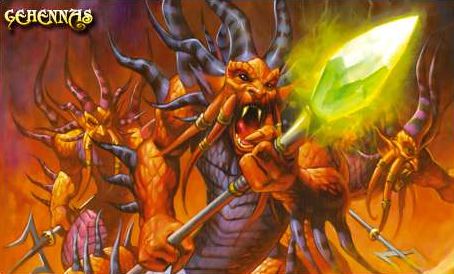 |
| Gehennas |
 |
| Garr |
 |
| Baron Geddon |
 |
| Shazzrah |
 |
| Golemagg |
 |
| Sulfuron |
 |
| Majordomo Executus |
Naturally, this was a source of both hilarity and frustration, and I will long remember the feeling of: "SHIT, I'M THE BOMB. RUN!"
Another fun encounter was Majordomo Executus, the penultimate boss in Molten Core. It was a challenging encounter as the boss came with eight adds. Majordomo himself was also very hard to keep control of, as he would frequently dump the tank into a fire pit and then wander off towards the rest of the raid in search of squishy victims. This meant that everyone had to be alert and so the encounter was a very dynamic one, with tanks running left and right and it was just a lot of fun to finally pin down the execution of it.
Defeating Majordomo meant that we now only had Ragnaros left before we would officially complete The Molten Core, and also all the raiding content that was currently available within the game.
 |
| Ragnaros |
In the month and a half that the raid had been together, the social dynamics within the mostly static group of people had evolved greatly. As you can imagine, if you bunged 40 unfamiliar people into a room and set them a task, there would be a lot of awkwardness at first. This was exactly what it was like at the start. Everyone was polite and accomodating, and I think everyone had the feeling that they were part of something momentous, so a lot of compromises were made in order to make the raid succesful.
As time passed however and everyone became more comfortable with each other, people began to relax back into their natural states, and a variety of cliques and personalities came out. There was the Kindred elite, as I liked to refer to them as. This included Gigamo, as well the main tank Pyrolobus and his priest, Ellen, along with several other characters. To my eyes, they kept themselves fairly aloof from the rest of the raid and socialised amongst themselves. Then, there was the friendly Kindred bunch, who were, well, friendly, and also completely bonkers. They were great fun to play with. Finally, there was "the rest", which comprised of most of the non-Kindred people.
As the weeks went by, more and more of the raid became Kindred, either through replacement of outsiders, or by people joining Kindred after feeling the rush of success and wanting more. The officers from The Revenants who were involved with Kindred (Chaspal, Zacker and myself) knew that the arrangement we had would soon become untenable, especially as now The Revenants itself had quite a few level 60's who were looking to make the jump to raiding. I flirted briefly with the idea of joining Kindred, but then I realised that although I wanted success, I wanted that success to be with The Revenants, a guild that had now come to feel like a bunch of friends, rather than a mass of strangers.
So, whilst we attended raids with Kindred and made attempts at Ragnaros. The other guild officers and I began to work towards securing the raiding future for us. Our first attempt at making an alliance didn't go particularly well - it was with a guild called Vikings of Midgard, and it wasn't that they were bad players, but their guild as a whole was too far behind The Revenants in the progression curve. This was made abundantly clear to us as we went on our first joint dungeon run. What should have been a routine run that took 2 hours actually ended up taking twice that long, and after that the alliance fizzled out.
We were then at a loss for a while as to what to do, but then, by a series of coincidences, things began to come together. During my time raiding with Kindred, I had often been put with a warrior from SWE (pronounced swee), and had become very good friends with him, along with other people from a guild called Blue Moon. As it turned out, Blue Moon and SWE were two guilds that were fairly tight, being as they were comprised of a lot of scandinavians, and players from continental Europe.
Chaspal and the leader of Blue Moon, a mage called Animagi, began talking and they got on like a house on fire. We then began joint runs to the lesser level 60 dungeons to test the waters. Given that most of the top players in the respective guilds were already fairly familiar with each other from raiding with Kindred, the runs went as smooth as honey. It also seemed to me that the ethos and goals and atmosphere within the three guilds seemed to gel pretty well and so the decision was made to strike an alliance, with the goal being to field a 40-man raid of our own separately from Kindred.
Then, we had to decide on a name. Nobody really had any good ideas, so we decided to just amalgamate the guild names.
"It should be ordered BM SWE REV," said the members of Blue Moon.
"No, it should be SWE BM REV," said SWE.
"REVBMSWE," said Chaspal.
I rolled my eyes and suggested we order them alphabetically.
And so, BMREVSWE was born. An alliance with a lot of promise, a lot of heart, but not a particularly good name.
16 June 2011
Memoires (Part 7 - Into the Core)
 | |
| The Molten Core |
It consisted of ten bosses, separated by many packs of lesser monsters (known as trash mobs). In order to make progress in the Core, raids needed to be long (typically 2+ hours), well organised and well led. It was also the first dungeon where the reset mechanic really began to matter. What's a reset mechanic? I hear you ask. Well, Blizzard realised that their dungeons would take a long time, so they made it so that once you killed a boss in the Molten Core, it would stay dead for a week, and then the dungeon would be reset meaning that the raid would have to start all over again.
It also meant that you were locked to that version of the dungeon for the week, so you couldn't jump from one instance of the dungeon to another one, killing the first boss over and over for the items, for example.
Flush from our success with Onyxia, Kindred began to organise raids to the Core. By this time, I was beginning to establish myself as a fairly respectable priest within the raid and so was often given the task of off-healing (where I would be healing one of the secondary tank groups).
I stood beside my frostsaber, Saer, along with the rest of the assembled warriors in front of a massive set of iron doors, which were slightly ajar. I stroked his mane, fingers twirling the soft fur absent mindedly as I listened to King Bronzebeard's edict, read out to us by Gigamo.
We stood on the precipice, steeling ourselves for what was to come. Over the past months, investigations by various factions had uncovered the true nature of the Blackrock Mountain. The Emperor of the Dark Iron Dwarves, who were sworn enemies of the bronzebeard dwarves, had freed the Firelord Ragnaros in his quest to gain greater power. Ragnaros was a malicious elemental spirit that had been trapped far underneath the ground for over a thousand years. His first act upon being released was to take control of the Dark Iron Dwarves, and put them to use creating an army of golems for his revenge. Ragnaros hollowed out the depths of Blackrock Mountain, making it his home, and opened a rift to the fire plane, allowing malcontent spirits into the world of Azeroth.
Today, we would be assaulting his lair, with the aim of stopping whatever schemes of destruction he had in place.
I patted Saer on the head, sending him away to the wild - the fiery depths of the core would be no place for a frostsaber. He nuzzled me gently and licked my face, a parting gift of affection, before loping off into the distance.
"This is not a suicide mission!" said Gigamo, raising his voice, "We can, and we will prevail. We have studied these lieutenants of Ragnaros, and we have studied him. We know how to beat him!"
I mentally checked over my list of provisions for the umpteenth time; potions, salves, bandages, food and water.
"Brothers and sisters, share your strength with each and with me, and we will not fall. Ragnaros will die. This I pledge, for Azeroth!"
Gigamo raised a fist in the air, rousing us all.
"For Azeroth!" came the unified response, our solidarity warming my heart.
Gigamo turned and marched through the doors, into the heart of the mountain. We followed, ready for anything.
As I passed through the thick iron of the doors, a wave of heat blasted my face. My eyes took a few seconds to adjust to the dim light, and once they did, I saw the scope of what lay before us. The inside of the mountain had been carefully crafted by the dwarves. We stood on a walkway which circled the whole cavern. Far below this walkway, in the centre of the mountain, lay a huge broiling pit of lava, casting dancing lights of orange and red onto the walls. Suspended above the lava was a shard of rock, carved into a spiral walkway that connected the depths of the mountain to the entrance where we stood. It was held in place by great chains, each link being bigger than a person, which lashed it to the bare rock of the mountain interior.
 |
| Blackrock Mountain Interior |
As I peered over the edge of the walkway, feeling the heat from the molten rock thrashing about hundreds of feet below, Chaspal came to my side.
"And guess where the entrance to this place is?" he said, a little sardonically.
"Down there?"
He nodded. "Come on, let's go."
Gigamo led the group over one of the chains onto the spiral walkway, and we followed it down and down into the bowels of the mountain. The air was thick with the smell of sulphur and ash, and with each passing step my breathing became more laboured.
The walkway led us to a small alcove with a window frame set in it, big enough for a man to fit through and carved ornately from the rock. Beyond it, I could only see lava.
Gigamo held up a small pumiced piece of rock. "Everyone, hold out your core shards!"
I did as instructed.
"Now, go through the window," he said, pointing at the alcove.
A bunch of murmers swept through the assembled raid. Gigamo did not wait to be questioned, he walked calmly through the window and leapt off the edge. We rushed forwards and put our heads through to see if he had fallen into the lava below, but there was no sign of his body.
Zacker shrugged. "Let's go!"
She was the next to leap, and as she impacted the lava, there was a flash of light and suddenly her body was gone, transported through the dimensional portal into the core itself.
"Talk about your leaps of faith," I murmured to no one in particular, before I jumped myself. I could feel the heat of the lava ripping at my body as I fell, and then, suddenly, I landed on the coolness of a rocky floor.
I was in the core.
We made progress quite quickly at first, going through the trash mobs. There were several wipes of course, as we had to learn the tactics on how to defeat each kind of monster. Gigamo was a very experienced player, having beta tested this dungeon, and so he knew his way around and provided us with valuable tactics that guided the raid. I concentrated hard on his every word, trying to commit them all to memory.
There were Molten Giants, huge behemoths that came in pairs and dealt a big amount of damage to the tanks, stressing the healers. Then there were Firelords, flame elementals who spawned little copies of themselves that would quickly replicate and overwhelm the raid if not killed in time, this tested the reactiveness of the damage dealers. There were also Core Hounds (referred to affectionately later on as doggies), which came in several different flavours and had various different abilities ranging from a mass stun to mass area of effect fire damage. Then there were various rock elementals which were hard to tank and liked to punt people left right and centre - they became a constant source of amusement / frustration as if you were not positioned correctly they would punt you off the edge and into the lava, where you would swim around taking damage until you died, and of course, the rest of the raid would point and laugh whilst this happened.
That first raid in the Molten Core was awesome. I really felt like a pioneer. This was the cutting edge of the end game and we were the first to attempt it. We were the best. I like being the best.
Finally, after some hours we made it to the first real boss. Lucifron.
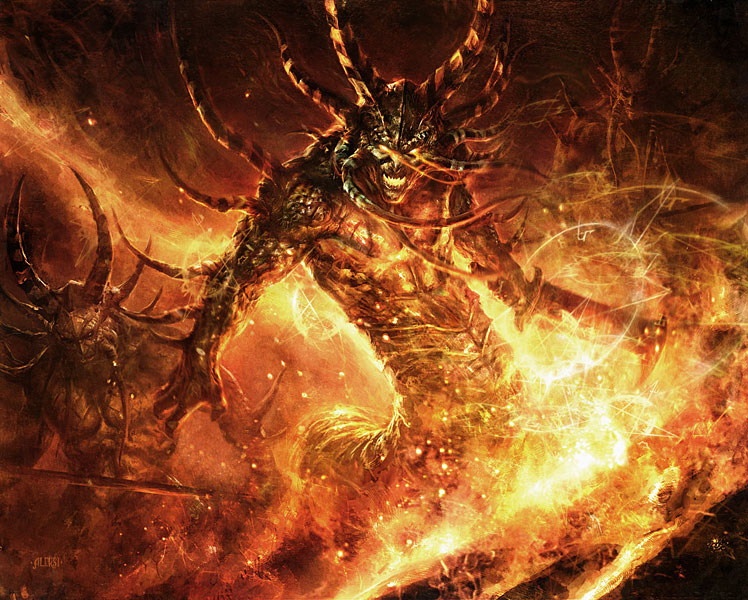 | |||
| Lucifron the Harbinger |
Even though Gigamo had told us all of this beforehand, the execution of the tactics was still difficult as it was the first time any of us had encountered this type of fight. I was assigned to heal one of the off tanks. By the end of the first raid, we had made some progress on the encounter, but had not fully managed to beat him.
 |
| Screencap of the Lucifron fight taken from a video made in 2006. By then, the encounter was routine. |
On the second raid, we nailed it and he died, to rapturous celebrations. We had officially made our first steps into the Molten Core. Word spread quickly through private messages and various guild chats and soon the congratulations began to roll in. The mages set up a town portal to Ironforge, the major hub city of the game at the time, and we rode in, announcing proudly in the general chat that Lucifron was down - it felt like we were heroes returning triumphantly from battle, which I guess, in the context of the game, was exactly what we were.
11 June 2011
Memoires (Part 6 - Onyxia)
...and beyond.
The Kindred and Co group enjoyed much success after the Azuregos kill. As word of our deed became more well known around the server, and as more and more people began to reach level 60, there was a clamour building to get spots in the raid group as at that time, no other guild was able to pull together a raid group with any noticeable success. However, slots were not just up for grabs and as the group became tighter raid spaces began to become reserved for regular goers - we were beginning to gel as a team and that was a really good feeling. The Kindred guild leadership were quite good about this, and it became a regular group of Kindred guild members alongside a regular group comprised of members from mainly three or four other guilds.
We took down Lord Kazzak shortly after Azuregos, and then turned our attention to Onyxia. This encounter was on a whole new level of difficulty. The fight was split into 3 phases, with varying tactics for each one that had to be memorised and honed to a high degree of competency. We set about this with gusto - the end game was still new to us and this novelty factor combined with the collective hunger to beat the encounter provided us with quite a high level of focus. If I remember correctly, it took us about two weeks to finally master the encounter, with something like three evenings per week dedicated to attempts. I'm not going to go over in detail the nature of the fight in this post, however, interested readers can visit here. Instead, I'll post some screenshots which I still have!
The fight where we first took her down lasted over 15 minutes. 15 minutes of intense concentration, with all the raid members playing their roles like following the steps in an intricate dance. The elation and rush when she finally went down was incredible, I think it was partly due to the fact that there is something intrinsically satisfying about co-operating as team - it was the same sort of feeling I had from playing the violin in my school's string quartet, except of course, slaying dragons was much cooler, and 40 people is more like an orchestra than a string quartet, making it feel very epic indeed.
However, the other part of the rush came from my innately competitive nature - we were the first to do it on the server. We had made our mark on the virtual world, and our names would be forever embedded in the history of this server. I think everyone wants to make an impact and leave a legacy, and when Onyxia was slain, that's what it felt like - we were shaping history in this virtual world.
When we slew Onyxia, we took her head back to Stormwind City, and it was hung up in the city as a grisly trophy.
As her head was hoisted, a rallying cry went out through the whole city announcing her death and crowning the raid as dragonslayers. Suddenly, the chat channels exploded with people offering their congratulations, and as the raid gathered underneath the head for some screenshots (which I sadly no longer have), many other players came to see the head and to check out the raid which had killed her. There were of course some snarky comments, which I put down to envy, but on the whole the response was overwhelmingly positive and honestly at that point, things felt awesome.
 |
| "Lady" Onyxia |
We took down Lord Kazzak shortly after Azuregos, and then turned our attention to Onyxia. This encounter was on a whole new level of difficulty. The fight was split into 3 phases, with varying tactics for each one that had to be memorised and honed to a high degree of competency. We set about this with gusto - the end game was still new to us and this novelty factor combined with the collective hunger to beat the encounter provided us with quite a high level of focus. If I remember correctly, it took us about two weeks to finally master the encounter, with something like three evenings per week dedicated to attempts. I'm not going to go over in detail the nature of the fight in this post, however, interested readers can visit here. Instead, I'll post some screenshots which I still have!
 |
| There she is! |
 |
| The main tank gets her attention whilst the rest of the raid runs in and gets into position (half the raid goes to her left and the other half goes to her right). |
 |
| Dragon hits main tank, damage dealers hit dragon. |
 |
| Phase 2 is a war betwen her breaths of fire and our ranged damage dealers (she won many times). |
 |
| But that doesn't mean the melee fighters are left standing - they had to kill all of Onyxia's little whelplings. |
 |
| Phase 3 is her landing. Cue lots of lava eruptions which are pretty painful. If you're curious about the interface, it shows the health and mana status of each member in the raid in the boxes on the left hand side. As you can see, the majority of the raid is dead. |
 |
| She kicked our ass many a time. |
 |
| We got her back just as many times in the end. |
The fight where we first took her down lasted over 15 minutes. 15 minutes of intense concentration, with all the raid members playing their roles like following the steps in an intricate dance. The elation and rush when she finally went down was incredible, I think it was partly due to the fact that there is something intrinsically satisfying about co-operating as team - it was the same sort of feeling I had from playing the violin in my school's string quartet, except of course, slaying dragons was much cooler, and 40 people is more like an orchestra than a string quartet, making it feel very epic indeed.
However, the other part of the rush came from my innately competitive nature - we were the first to do it on the server. We had made our mark on the virtual world, and our names would be forever embedded in the history of this server. I think everyone wants to make an impact and leave a legacy, and when Onyxia was slain, that's what it felt like - we were shaping history in this virtual world.
When we slew Onyxia, we took her head back to Stormwind City, and it was hung up in the city as a grisly trophy.
 | |
| Onyxia's Head |
Subscribe to:
Posts (Atom)