It's better to have loved and lost than never to have loved at all.
30 September 2015


9 May 2015
Can we share the pie better please?
I turned 26 recently - less than a week ago in fact.
It's a significant age because now, no matter how I try to pervert mathematics, there is no getting around the fact that I am closer to 30 than 20, and so, perhaps in recognition (or resignation) that I'm well on my way to being an Adult(tm), I decided to get involved and vote in the general election this year.
Naturally, It wouldn't be enough to pick at random from the four selections I would have (I say four, because to a 2nd generation immigrant UKIP is as much of a choice as eating dirt is, but I digress), I would have to do a bit of research to understand what all this political hoo-ha was all about.
I discovered many things during this research - for instance - that my political beliefs align quite left of the spectrum, with a fairly liberal outlook (you can figure yours out here if interested: https://www.politicalcompass.org/test), but really what I felt most strongly about out of all the myriad of topics involved in the socio-political landscape of our modern society is income inequality.
By whichever metric you want to measure it, we are very unequal. I provide just one example (from this illuminating series of graphs on The Atlantic).
It's a significant age because now, no matter how I try to pervert mathematics, there is no getting around the fact that I am closer to 30 than 20, and so, perhaps in recognition (or resignation) that I'm well on my way to being an Adult(tm), I decided to get involved and vote in the general election this year.
Naturally, It wouldn't be enough to pick at random from the four selections I would have (I say four, because to a 2nd generation immigrant UKIP is as much of a choice as eating dirt is, but I digress), I would have to do a bit of research to understand what all this political hoo-ha was all about.
I discovered many things during this research - for instance - that my political beliefs align quite left of the spectrum, with a fairly liberal outlook (you can figure yours out here if interested: https://www.politicalcompass.org/test), but really what I felt most strongly about out of all the myriad of topics involved in the socio-political landscape of our modern society is income inequality.
By whichever metric you want to measure it, we are very unequal. I provide just one example (from this illuminating series of graphs on The Atlantic).
 |
| To summarise: One line is a lot steeper than the others. This is bad. |
Now, don't get me wrong, I'm not saying that inequality in itself is bad. I understand we live in a capitalist system; an economic system where wealth creation is founded on the principle that by making the pie bigger, everyone gets a bigger share and that incentives in the form of possible massive wealth are required for people to take the requisite risks in innovating, setting up businesses and doing all the other good shizzle that have provided our society with all of the amenities that we enjoy today. However, not all inequality is equal.
On a side note - the capitalist system seems to be right now the best economic system we've implemented to date, however, it won't be the last. The capitalist system is founded on the assumption that growth can be sustained infinitely. This is obviously ridiculous, but I believe that it's not really something we as a society have had to contend with up till now. Earth is a finite resource. This by definition means that capitalism is not going to be a suitable economic system for the end-state - where presumably we will be exploiting all of Earth's resources, but doing so in a sustainable way (because there is no other way to do so and ensure the continued survival of the human race).
I'm not here to lay out the "how did we get here's" or to debate about the "how can we fix this", because I am not educated enough to know the history, and not knowledgeable enough to come up with any credible solutions.
But in the light of the election results in the UK, it seems that we are going to continue down the road where we've come from, which makes me think that the graphs above are not going to get better anytime soon, and I think that's super bad. It makes me wonder whether I'm missing something, or whether other people are missing something.
Sure, keeping the NHS free is all well and good, and trying to aid people in buying homes is also great, but I can't help but feel that ultimately these problems are partly caused by the fact that inequality has grown so large - if perhaps not so much money was tied up in the financial markets and stock portfolios and instead being paid to the people in salary, wouldn't we all spend more as a result, fuelling a virtuous cycle in the economy?
 |
| I didn't want this post to get too serious so here is a picture of a puppy and a kitten. |
More income means more tax pounds - a source of funding for the NHS perhaps? More income might also make it more palatable to cut the benefits system too. More income might help people get on the housing ladder and finally, more income would allow us all to participate in society more fully. Culture costs money. Art costs money. Having more money means more of both.
More than the monetary aspect though, I think there's another important reason why the amount of inequality we see today is bad.
The part of me that is jealous of the fact that I'm not a multi-million net worth individual would argue that well - I work hard at my job, as do many other people, is it really fair that the compensation levels should differ so much even though no less effort is being expended? Although this visceral reaction probably echoes many people's, it is hardly a convincing argument.
No. The real reason comes from a more pragmatic perspective.
In a society like ours, there will always be inequality. It is ingrained in the system and necessary for the system to function. However, the aspirational culture we all participate in let us all think that we'll be in a position to reach the stars when this is perhaps the very opposite of the truth. We turn a blind eye to the fact that even if there were perfect social mobility, we would still be arranged in a pyramid structure much like we are now. Some people would be at the metaphorical "top" - the CEOs, the entrepreneurs and so forth, others would be in the middle class and we would still have to have people doing the low skilled jobs at the bottom.
The problem really is that we think of it as a "top" or a "bottom" at all. All are necessary for the functioning of this society, and as sad as it may to be admit, it might not be wrong to say that the reason we value a CEO (in terms of pay) much more than a janitor is simply because he will have a much bigger impact on a shareholder's expected earnings. But, unfortunately, more than that, because really monetary value is representative of just "value", when we pay minimum wage to a cleaner such that they are not able to participate as much as they would like in society, we are not only facilitating a wealth of economic problems, but also telling them that they are "just" a cleaner. What CEO would think of themselves in all seriousness as "just" the CEO?
As the recent tube strike showed, just because we take something for granted doesn't mean it's not important, and just because we can all do a job it doesn't render it without value - because - well, it still needs to be done.
 |
| Second picture break! This is how I eat a bacon sandwich too. Problem? |
I want to close out by using an analogy from the days of my yore, when I used to be heavily into video games. Back in the days of World of Warcraft, we would get together, a bunch of people 40 strong, to try and slay dragons (and other ghastly world threatening entities). In that group, two of the most prestigious positions were the main tank and the main healer, why? If the main tank (who held the dragon's attention and took the brunt of the dragon's ire) died, then it was a given that the attempt would probably fail. If the main healer died, the main tank would probably die as a result.
So, raids far and wide recruited for the best, most talented players they could find to fill these spots, even though measuring the performance between one tank/healer or the other was sometimes a fairly subjective thing. The rest of the riff-raff, the damage dealers, were pretty much interchangeable. Do you stab the dragon with a dagger or fire arrows or frost-bolts at it? Whatever, it doesn't matter, just do your thing (but don't stand in the fire).
My own raiding guild followed this philosophy too, and, you know, we made a pretty good raid. For a long time we were the 2nd best on our server (and then even the first best for a time too!). But, what kept us from reaching the big leagues, from becoming great? The answer, it turned out in the end, was the quality of our damage dealers.
Although individually the job they did was not flashy or noticeable - and there was no immediate visible feedback for their efforts (such as the tank living or dying), the small accumulation of improvements to each of their damage outputs in the end yielded a big difference.
It was the difference between taking 10 minutes to kill a dragon versus 5 minutes, mitigating 5 minutes worth of risk for the raid - 5 minutes of the main tank being bitten and clawed at, 5 minutes of the main healer concentrating without blinking on each sudden movement in the health of the main tank, 5 minutes of the raid having to avoid the fire.
It was what turned a good raid into a great raid.
We have in our society now, a good raid.
We have strong corporations who make great products and a robust government. They are the ones in the news and the spotlights, the main tanks and the main healers. We of course want the best, and so we are paying out of our noses for the best of the 1%. However though, this means the people who crank the handles of industry, the damage dealers, are not being empowered enough.
So maybe, just maybe, if we focused a little more on giving more attention to the people and a little less to the top, we could turn a good raid into a better one. We could turn a good society into a better one.
27 January 2015
A good morning indeed.
I stepped out of the tube station into the chill morning air.
A man giving away TimeOut magazines stepped forward from where he was waiting on the edge of the pavement for the latest batch of commuters to shuffle out of the underground.
He was not like the others - blank faces and bored eyes. Perhaps he was new on the job, not yet dulled by the dull affair of peddling his wares.
"Good morning!" He exclaimed, words as cheery as his smile. "Time Out magazine anyone?"
I didn't take one, and neither was I in a bad mood in need of cheering up, but cheer me up he did.
I hope he realises that for that moment, in that instant, he wasn't just handing out magazines. Keep it up, TimeOut man.
A man giving away TimeOut magazines stepped forward from where he was waiting on the edge of the pavement for the latest batch of commuters to shuffle out of the underground.
He was not like the others - blank faces and bored eyes. Perhaps he was new on the job, not yet dulled by the dull affair of peddling his wares.
"Good morning!" He exclaimed, words as cheery as his smile. "Time Out magazine anyone?"
I didn't take one, and neither was I in a bad mood in need of cheering up, but cheer me up he did.
I hope he realises that for that moment, in that instant, he wasn't just handing out magazines. Keep it up, TimeOut man.
30 October 2014
My Journey of Fitness
Recently, over the last year or so (especially over the last 6 months), I've had quite a few people comment on my physical appearance.
"You've lost weight." Is a common one.
"Have you been going to the gym?" Is another.
"You look in great shape." An oft heard third.
I wanted to highlight this not for the sake of my own vanity (although, clearly I'm not opposed to getting these sorts of comments), but for a rather different reason. It would seem, then, that I have arrived at the destination of being "fit", as nebulous a term as it is.
Certainly, my own self three or four years prior would have thought so. He would have looked in the mirror at my physique now and would have been consumed with jealousy and longing. A goal to attain, something to "get", an achievement to tick off on the list of things to do in life; "get fit". Concerned only with the external, the image, the representation. Knowing perhaps, but ignoring, that the really the important things to get right were the things on the inside - the substance.
Looking back now from where I stand today, with the knowledge attained from consistent effort applied over the years, I realise how hopelessly naive I was back then. There is no end goal here, there is no summit to the mountain. We are not even climbing a mountain in the first place. The journey of fitness is not so much a physical progression as a spiritual one and being fit is not an achievement, it is a state of being. The real benefits are not the hard abs and defined pecs, it is the hardening of discipline and the definition of character.
Of course, the visual progression is the easiest to see. So let's lay that out below and get it out of the way.


I was the Captain of the team, and I had long ago decided I was going to give it my all to try and bring the trophy home for Cambridge. I even started going to the gym, doing a whole bunch of random exercises with really little idea of what I was about. But, I had a big motivation, which kept me consistent, and I began to notice slight changes.
"You've lost weight." Is a common one.
"Have you been going to the gym?" Is another.
"You look in great shape." An oft heard third.
I wanted to highlight this not for the sake of my own vanity (although, clearly I'm not opposed to getting these sorts of comments), but for a rather different reason. It would seem, then, that I have arrived at the destination of being "fit", as nebulous a term as it is.
Certainly, my own self three or four years prior would have thought so. He would have looked in the mirror at my physique now and would have been consumed with jealousy and longing. A goal to attain, something to "get", an achievement to tick off on the list of things to do in life; "get fit". Concerned only with the external, the image, the representation. Knowing perhaps, but ignoring, that the really the important things to get right were the things on the inside - the substance.
Looking back now from where I stand today, with the knowledge attained from consistent effort applied over the years, I realise how hopelessly naive I was back then. There is no end goal here, there is no summit to the mountain. We are not even climbing a mountain in the first place. The journey of fitness is not so much a physical progression as a spiritual one and being fit is not an achievement, it is a state of being. The real benefits are not the hard abs and defined pecs, it is the hardening of discipline and the definition of character.
Of course, the visual progression is the easiest to see. So let's lay that out below and get it out of the way.
2006 me.
2011 me.
2014 me.
I am of course pleased with the physical transformation from a skinny-fat kid to a fairly "fit" guy. And, I won't lie that of course aesthetics was part of the reason I hopped on the fitness bandwagon all those years ago, and it is part of the reason why I continue to train regularly today. But I want to put it to one side for now, because I really want to talk about the other things - the change of the internal me, which as a progression has mirrored the external changes (but has probably been even more drastic).
I used to hold some very strict beliefs about myself - some of them very negative. One of those beliefs was that no matter what I tried, I would always be quite chubby. Because, back then, I was playing Badminton for Devon County. I was playing 2-3 hours four or more times a week. How could I be doing that much exercise and yet still be chubby? Along with this was also the belief that I was unattractive, and I don't mean on a physical level, I mean that on a deep fundamental level, I believed I was somehow flawed as a person and different (in an inferior way). The worst belief though by far I held was that these things were innate - they were an inextricable part of my being, unchangeable, immutable. It was who I was.
It's interesting thinking back now to the person I was then, and seeing how trapped I was by my these beliefs. And, even through a fair portion of University, I was never really fully secure in myself. I was the guy in the group who laughed along with the jokes, who pandered to everyone's wishes, the serial pleaser who was too scared to stand out and show his own personality - but not just because I was scared, but also because partly I didn't even know what that personality really was because I was too busy spending most of my energy trying just to fit in.
The one area I was consistently good at though was academics. And again it's funny now thinking back. I wonder how much of that success was due to my actual intelligence and how much of it was due to my own self-held belief that I was intelligent, which therefore engendered behaviours that led me to become what I believed I was. After a certain point, should we even try to distinguish them? Fake it till you make it, right?
It's odd though that I never made the connection at that time that I could apply that to the rest of my life.
So, I muddled through Uni, until I arrived in my final year, preparing for Badminton Varsity.
I was then lucky to be introduced to www.stronglifts.com, and decided to give it a shot. And it changed my life.
I stepped into the gym (Selwyn College's gym - a bare-bones garage with old school solid iron plates and equipment that the paint was peeling off of) on those first workouts, squatting about 40 kg, bench pressing 30 kg and I forget my other stats. The program seemed a little bit crazy to me at the time - add 2.5 kg each workout and keep going, but, I followed it, placing my faith in the testimonials on the internet and also the glimmer of hope in my heart that I could emulate some of the success stories there.
It is difficult to describe the feeling of those first few months.
Every workout I went in and I added 2.5kg to the bar. Soon, weights that were previously unmanageable became liftable, and then after not much more time, comfortable.
After two weeks, I could already feel a change in myself. After a month, that change was obvious in the mirror. It was like I had discovered a new source of power in my body, and with each workout I was opening the taps. It was addictive, a completely heady feeling. I felt at that point so in control of my own destiny.
And that was when it hit me - that the limiting belief I had held all my life as fact - that I could never get fit - was in fact nothing but a belief. It forced me to re-examine everything, because if I was proving to myself week after week that I could surpass my previous limit, that I could change this previously immutable aspect of myself, then what else could I change, given the right motivation and approach?
The answer, over the next few years, turned out to be a lot.
I now go to the gym about four times a week in the mornings before work. It's become my panacea, a keystone habit that helps me define myself, keep perspective and de-stress.
I firmly believe we are not a species meant for sitting in office chairs for 8-10 hours a day. Not so long ago we were nomadic hunters on the great plains of Africa, where our preferred method of hunting was to exhaust our prey to death. Society has come a long way since then, but evolutionarily speaking nothing much has changed.
Back then, mother nature was the personal trainer - you hunted, you ran, you exerted yourself - because if you didn't, you didn't eat. Now though, there is no natural pressure, and so in this society of over-abundance we grow fat and lazy and develop bad posture and even worse vices. I firmly believe that this is not a sustainable way to live.
So we should be the mother nature to ourselves, and use our rational thinking to set our animal self the challenges it needs. To reconnect with the glorious physicality that has now been lost from so much of our lives, to restore the balance.
Fitness is not an end goal. It is a journey, a state of being, and for me, it was the cornerstone upon which I changed my life for the better. It led me to understand who I really was, tested the limits of my discipline, my willpower and my character and helped me understand where I was in relation to the man that I wanted to be. It showed me (and continues to show me) that every reward has to be earned, that every achievement comes as the result of consistent hard work. There are no cutting corners in this arena. No shortcuts. If I don't achieve a goal, there is no one else to blame but me. You can make excuse after excuse, but at the end of the day if you can't lift that barbell then you can't lift it.
I used to feel that I was owed certain things by the world - a satisfying career, a loving girlfriend, a comfortable life, just by merely existing. Writing this out makes me cringe. The world doesn't owe me anything, only existence. Nobody else is going to make me into the man I want to be. Everything is up to me. Of course, everybody "knows" this. Just as everybody "knows" how terrible it must feel to lose a family member. But there's knowing - the hazy, slightly abstracted theory. And there's knowing - the concrete, irrevocable knowledge that sits in your bones. They are not the same.
If you're out there, and you feel like how I felt all those years ago. Maybe what you need isn't alcohol, or cigarettes, or porn or whatever else you use to numb the pain and hide from the doubt. Maybe what you need is the iron.
13 February 2012
Review: Final Fantasy XIII-2

*Spoiler Warning - You have been warned!*
If you've been any sort of Final Fantasy, or hell, gaming fan over the last few years, you'll probably be aware of the furore that was made over the release of Final Fantasy XIII. It was like Square Enix omni-slashed down the middle of the Final Fantasy fanbase with the introduction of new battle mechanics and the much more story focused gameplay. Also, if you've been any sort of Final Fantasy fan, you'll probably have your own opinion on whether the changes worked or not.
For me, it was a partial success. I loved the new battle mechanics; the quick pace and the paradigm shifts which gave it a nice layer of depth and also a new urgency and visual flair which the older games lacked. I also liked the difficulty (towards the latter stages of the game); the game forced the player to have a good grasp of the mechanics to succeed, which was nice. Where the game fell down though, was its mind numbing linearity through the first half. In a game, even in a Final Fantasy, gameplay should still be king, and clearly when all a player has to do is run down a corridor and press X, this is not the case.
I do realise what Square-Enix were trying to do; they were trying to tell a character focused story, and for people who connected with the characters and their struggles, I imagine it would have been a much more fun ride, but personally, I found much of the dialogue and interactions forced and a little bit hokey. It wasn't that the voice work was of poor quality (it was good, although I wish Vanille could have been less ear achingly high pitched), it was just something about the character dynamics that betrayed too much of the authorial hand behind it; things didn't feel like they flowed naturally.
So, by the genre defining standards that Final Fantasies usually set, it was a bit of a mixed bag, and after I finished the game I put down the controller with as much of a feeling that I'd endured a trial as the feeling you get when you close a good book.
Anyhow, fast forward to the sequel; only the second time that the main franchise has received a direct continuation. I've now sank about 55 hours into the game, and am on the verge of completing the post game (just need that damn slot machine to pay out...), so you can rest assured my opinions are not formed from a half assed toe dip into the world of Pulse and Cocoon. Nope. I've wound the game around myself like a noose, and have pretty much devoted the last week and a bit of my life to it.
So, the story in a nutshell is a bit of a deviation from the first game. Lightning gets sucked into the Unseen realm, into Valhalla, where she is now locked in an endless war with the game's antagonist, whose goals are of course, the destruction of life, the universe and everything. Whilst this is going on, Noel, a boy from the future is tasked by Lightning to bring Serah to her, and along the way, they must fix a world history that left to itself would result in the doom of the human race. So far so good; it wouldn't quite be a Final Fantasy if the fate of everyone and their chocobos weren't at stake.
 |
| The game's protagonists |
The effect of the time travelling storyline on gameplay essentially means that all linearity has gone flying out of the window, as the player is given a good amount of choice about where to go and what to do very early on in the game. There are a plethora of sidequests and distractions for those who want to explore and take a break from the main quest., and although a lot of them are fairly standard fetch or kill quests, the slightly tweaked battle system (which is now even better) makes them fun. The ill effects of making the game so non-linear is that although I was never stuck on where to go next, fitting all the pieces of the plot puzzle together was a fairly arduous task, not aided by the fact that the writers saved all the important reveals until nearly the final act. This made the character motivations seem a little murky for much of the game, and put a damper on what in hindsight was a very character driven story which was also surprisingly dark for a Final Fantasy. I don't think there has been another major villain in the series who had as much humanity as Caius Ballad, and yet he still managed to be a great villain and provides a thrilling final boss fight along with a great theme, and this is something that for me bodes well for any future installments in the series.
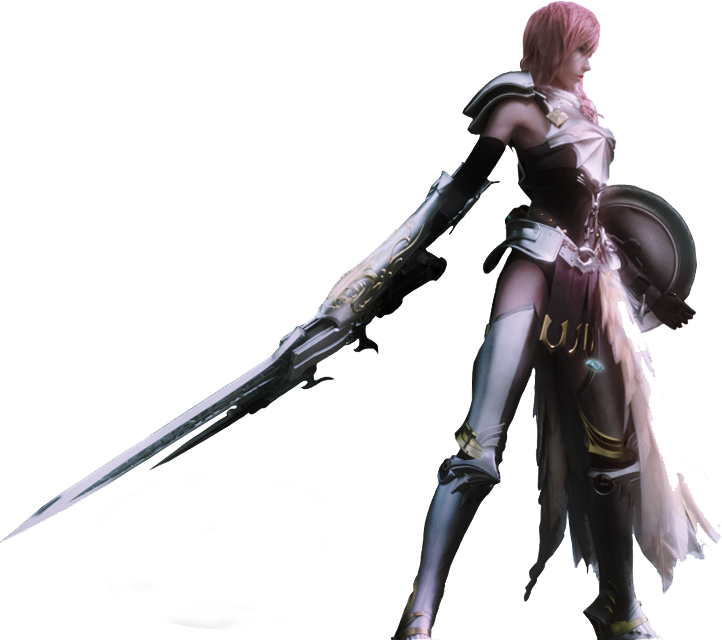 |
| Lightning's badass new outfit. Feather half skirts are apparently considered timeless fashion in Valhalla. |
I think had they told the story to it's conclusion, it would have made this a truly great Final Fantasy. All the other elements were there; sympathetic characters, a satisfying and interesting post game, chocobo racing, a few super bosses (which were actually far too easy) and that mysterious Final Fantasy fun factor which just didn't seem to be present in XIII.
It also had a much better realised and cohesive soundtrack than FFXIII, and I found it both refreshing and enjoyable, albeit a departure from what Uematsu would have done. I think the music for FFXIII was a little bit all over the place, and although Hamauzu did his best to provide a cohesive soundtrack, he went about it a little too bluntly, weaving too few themes into too many tracks. It isn't so in the sequel, which musically, has developed a great deal; there is a huge variety of styles present, from jazzy battle tunes to a heavy metal chocobo theme which had me chuckling, and a lot more vocal tracks than previously. I feel most of it works really well, and although it won't be what Uematsu fans would expect from a "classic" FF soundtrack, it is a good evolution in my books. I do wish that the main Final Fantasy theme and the Prelude would have been included in all their glory however, as for me they are like the musical stamp that says "Here. This is a Final Fantasy."
For all its good points however, there are a few things which disappointed me a bit about the game, story conclusion aside. Although the concept of time travel was great, I feel like the team didn't flesh out the way the world would change over the years as much as they could have, so in some ways it was difficult to feel the effects of the passage of time, as for example, Bresha Ruins in the year 300 was pretty much the same as it was 200 years previously, except for the weather. Would there not be collapsed tunnels or plant growth or any number of things that would signify the passage of time? Also, the use of the Historia Crux, which is basically a glorified menu, along with the lack of a world map, really stamped out any feeling of "place". This might seem like a minor issue to some, but it bothers me greatly, because one of the trademarks for Final Fantasy games was the character the setting provided; Spira is different from Vana'diel, is different from the world of FFVII, is different from...well, you get where I'm going with this. For XIII and XIII-2, we have the beautiful locations of Pulse and Cocoon, but rarely do we get any sense of where the story events take place in the world in relation to each other. There's no sense of any sort of journey; it's just clicking through a list of menus. Bring back the world map please.
Oh, and there's no summonable Eidolons, which makes me sadface. But anyway....
All things considered; as a game, XIII-2 is a fine game. It's one of the few Final Fantasies which I have genuinely enjoyed the post-game in and it's just a really fun experience, which is probably the most important thing (although very much on the easy side). As a Final Fantasy, it addresses a lot of the issues that I had with XIII, and is a respectable addition to the series. However, it could have been so much more, and I think the amount of wasted potential, more than anything else, makes the shortcomings in the title more disappointing than they otherwise might have been.
If you hated XIII because of the linearity, the storyline or the characters, give XIII-2 a try. It's definitely a step up. If you hated XIII because of the battle mechanics, then you should probably get your kicks elsewhere; not a lot has changed.
Final Verdict: 7 / 10
3 December 2011
A Great Australian Adventure (Part 7)
Amazingly though, as we got on the road, the clouds began to lighten, and before long we began to see bits of blue. The next hour or so saw the team turn into cloud patch chasers, with us trailering until we sat in direct sunlight, at which point we would find a place to stop and soak up as much of the sun as possible until the shifting clouds forced us to move on.
After an hour, we stopped at the side of the road; there was no need to chase blue patches anymore because it appeared the cloud cover had completely broken. Alisdair's unrelenting optimism had completely flummoxed the outback's weather system, and the sun shone down on our car.
We stopped in the bay for some time, and were joined by MIT and Eclipse - a team from Montreal. There was a festive mood in the air; one of the Eclipse team members had brought out a guitar and sang some songs as we waited collectively for our batteries to recover from being completely emptied.
 |
| This is a major gig in the outback; a sandy rest area, a man with a guitar and a megaphone. |
 |
| Zoom zoom zoom. |
When we got into Port Augusta, the array was feeding the most energy into the battery than it had ever done during the race.
The team reached the final control stop, jubilant. This was the way how I had wanted the race to end, with Endeavour rolling under her own steam to the finish, and by some miracle, this was the way it had happened. The road into Adelaide was closed to solar cars as of that morning by the South Australian police, as it was deemed to be too busy for solar convoys, so we put the car on the trailer and drove the rest of the way into Adelaide. We had always expected this would be the case as soon as we had to trailer the car on Day 1, and so for us, Port Augusta was the real finish line, and in my view, despite all expectations to the contrary, we crossed that line with aplomb.
 |
| Trailering the car up at Port Augusta. The real end of the race for us. |
 |
| The final few metres... |
I also felt like I had accomplished something really tremendous, and it was an extremely fulfilling sort of feeling. It's the sort of thing I can hold up to myself and say: "Look, you drove a solar car across the outback...anything else will be peanuts." It was also so real. Because, let's face it, when you receive a payslip with some numbers on it, it's satisfying of course, but this...jumping into the icy cold water of the fountain, with the blazing sun overhead, screaming my heart out surrounded by the whole team, knowing what everyone had been through to get to that point.
It was a primal moment of triumph. A once in a lifetime experience that reminded me what it was to truly be alive.
Screw pay checks, I'll have more of this please.
I leave you with some pictures from our trip. I hope you've enjoyed reading this series of posts!
 |
| Workshop at BOC. |
 |
| Making sparks. |
 |
| Testing brake lights. |
 |
| CUER light painting! |
 |
| Painting painting. |
 |
| Cockpit view with the rear view camera on. |
 |
| Hidden Valley pit garage. |
 |
| This Discovery was definitely not used as a Chelsea tractor. |
 |
| Stopped at the end of the day. |
 |
| Road Train! |
 |
| Endless cloud. |
 |
| The Stuart Highway (and cloud). |
 |
| Nose to tail with Waterloo. |
 |
| One beautiful sunset. |
 |
| Another beautiful sunset. |
 |
| Ashiya (JPN), Socrat (TUR), CUER (UK), Onda Solare (ITA), Eclipse (CAN), Anadolu (TUR). |
 |
| The finish line! |
 |
| It's a tradition for teams to jump in the fountain. |
 |
| Future solar car designer appraises Endeavour? |
 |
| Award for safety and professionalism. Lucy Fielding is happy to collect. |
 |
| The winners. |
 |
| Australia: Our clouds will blot out the sun! CUER: Then we will drive in the shade. |
 |
| So long Australia. |
30 November 2011
A Great Australian Adventure (Part 6)
Day 4 began quite well.
I took the first stint in the car. The weather wasn't great; there was sun, but also a lot of cloud cover. Despite this, Endeavour chugged along the Stuart Highway at a steady speed of around 50 to 55 km/h. This stint was somewhat different to the first one I drove. For starters, a rather startled insect of some sort had made the car it's home in the night and was now flapping around in the driver cabin, no doubt rather perplexed by the situation it had found itself in. Also, Endeavour began to experience strange power losses, where I would lose drive for four or five seconds before it would come in again. Sometimes it was more severe, requiring a complete reset of the car to get it going again. Fortunately, most of the times this happened it was possible to keep Endeavour rolling whilst the system reset and then pick up the speed again.
After my stint, Emil hopped in the car, and then proceeded to drive a perfect stint with absolutely no problems. A fickle thing, our Endeavour. After the control stop which we reached at the end of Emil's stint, I got back in the car and within thirty minutes she had broken down completely at the side of the road, refusing to budge despite repeated restarts. Very fickle. Perhaps it was because I'd said that those solar cells made her look fat, or something.
At this point, we were sitting under clouds, so once again the decision was made to put her on the trailer and get the car to Alice Springs, which marked the halfway point of our race.
After starting so well, I was gravely disappointed at yet another day where we had to trailer. The more frustrating thing was that the power losses seemed random and inexplicable, and left the electrical team scratching their heads as to the cause.
Surprisingly, after some time charging, the battery reported itself as full. And so, suspecting a loose connection somewhere to be the cause of the cut-out earlier in the day, Dan and Ed ran over the electronics with a fine comb in the evening.
We awoke for Day 5 to a nice clear sunrise, and set off with Tom in the solar car. I was in the Discovery, and since Endeavour seemed to be running sweetly, things were quite relaxed.
By this point, the team had become pretty well oiled. The driving was relaxed and everyone knew what to do. It certainly wasn't like the tense and tumultuous Day 1. After Lucy's stint, we could see heavy cloud cover on the horizon; inwardly, I sighed. We had some inkling that the weather wasn't going to be great in the south half of Australia, but still, I had always nursed a hope that the weather reports would be wrong.
As Tom started on his stint, we could see rain in the distance, and then lightning. It seemed that the outback had gotten tired of sun, and had ordered a full blown storm for that afternoon.
Given that Endeavour is essentially a high voltage battery pack on wheels, and completely not waterproof, we were rightly concerned when it started to drizzle on us. However, we kept going as far as we dared, until the visibility became poor enough that Tom could not see, and then we pulled over.
With rain lashing down, wind whipping all around and thunder booming overhead, we jumped out and hastily wrapped the tarp on the car, weathering the worst of the conditions. There was obviously no way we could continue driving under such conditions, so the only thing to do was to put the tarped car on the trailer and see if we could get out of the storm.
At this point, I thought I really had seen it all. The day grew dark enough that we had to use headlights, and Endeavour on the trailer was lost in a cloud of spray kicked up by the Discovery as we raced along the sodden road towards the light.
When we finally got out of the rain and lightning, it was still heavily overcast and it was nearly the end of the day. We decided to keep trailering until we reached Cadney Homestead, a remote truck stop where we made camp for the night. The idea was to cross fingers and hope for a better day on the morrow, and thus save as much battery in Endeavour as possible.
It turned out we weren't the only team to get caught out by the most un-Australian weather ever. Ten other teams ended up at Cadney, turning the quiet truck stop into a menagerie of solar car teams from all across the world. There was a jovial mood in the evening as teams swapped war stories and joked about the cloud, but it was still deeply frustrating. We all knew we could have done so much better if only there had been sun, and it began to seem increasingly unlikely that we would best the 2009 team's attempt of 1616 km. However, they did have perfect conditions for the whole race, and so that at least didn't bother me too much.
It rained the whole night, and when we woke on Day 6, the conditions were no different. However, we had a mostly full battery, and so whilst all the other teams opted to trailer out of Cadney, we decided to drive Endeavour till she ran flat, given that the conditions till the end of the race were predicted to be the same heavy cloud.
It was a very british thing to do, to give two fingers to the weather and drive a solar car when there wasn't any sun. I felt very proud as Endeavour slowly accelerated out of Cadney, and some of the homestead's residents turned out to wave us off. I also felt very sad, because if there was no change in the weather (and there was no reason to believe there would be), Day 6 would be the last day of driving the solar car. The worst thing for me was that we would go out with a whimper; an insignificant speck of a solar car team who had been ground down by the vast, merciless outback and were forced, with no battery left, to finally concede an ignominious defeat at the side of the road.
And so it was. We lowered the speed in an effort to up efficiency, crawling along sometimes at 40 km/h or less and managed a full stint with me in the car. Then Emil hopped in and we carried on. It drizzled on and off, however we didn't consider it heavy enough to stop us. But finally, inevitably, the electrical team made the decision to pull into a rest area to put the car on the trailer and call our race to an end.
However, perhaps Emil had decided he wanted one last hurrah, or perhaps he had actually mis-heard and flicked the throttle by mistake like he explained later. As the lead car pulled into the rest area, he throttled Endeavour up to the max, gunning for freedom. Personally, I think he wanted what I wanted too: for Endeavour to go out in style before it was retired for good. The lead car was quick to catch up, yet Endeavour raced along, defiant, for a few hundred metres before the low voltage protection kicked in; we had run her flat, the car had given all it had to give.
We were done.
The drive to our next campsite, Lake Hart, was a very quiet affair. Not even the spectacular scenery could lift my rather damp mood.
At the evening team meeting, Alisdair laid out our plans for if there was to be sun on the final day. I nodded along but honestly I thought it was a waste of breath; the cloud was thick and blanketed the sky as far as the eye could see, and the conditions were forecasted to be the same all the way to the end. And besides, I had mentally sort of come to terms with finishing the race on such a low note, and was now ready to get to Adelaide and back to civilisation, preferably as quickly as possible.
The end was near.
I took the first stint in the car. The weather wasn't great; there was sun, but also a lot of cloud cover. Despite this, Endeavour chugged along the Stuart Highway at a steady speed of around 50 to 55 km/h. This stint was somewhat different to the first one I drove. For starters, a rather startled insect of some sort had made the car it's home in the night and was now flapping around in the driver cabin, no doubt rather perplexed by the situation it had found itself in. Also, Endeavour began to experience strange power losses, where I would lose drive for four or five seconds before it would come in again. Sometimes it was more severe, requiring a complete reset of the car to get it going again. Fortunately, most of the times this happened it was possible to keep Endeavour rolling whilst the system reset and then pick up the speed again.
 |
| Clouds but sunlight. The outback is weird. |
 |
| Sometimes, it sets fire to itself too...the outback is weird. |
At this point, we were sitting under clouds, so once again the decision was made to put her on the trailer and get the car to Alice Springs, which marked the halfway point of our race.
After starting so well, I was gravely disappointed at yet another day where we had to trailer. The more frustrating thing was that the power losses seemed random and inexplicable, and left the electrical team scratching their heads as to the cause.
 |
| The usual end of day proceedings + confused Dan and Ed. |
We awoke for Day 5 to a nice clear sunrise, and set off with Tom in the solar car. I was in the Discovery, and since Endeavour seemed to be running sweetly, things were quite relaxed.
 |
| A relaxing sit. |
As Tom started on his stint, we could see rain in the distance, and then lightning. It seemed that the outback had gotten tired of sun, and had ordered a full blown storm for that afternoon.
 |
| Twas like driving into the mouth of (a very wet) hell. |
 |
| Actually, this picture was taken in the Yorkshire Dales. |
At this point, I thought I really had seen it all. The day grew dark enough that we had to use headlights, and Endeavour on the trailer was lost in a cloud of spray kicked up by the Discovery as we raced along the sodden road towards the light.
When we finally got out of the rain and lightning, it was still heavily overcast and it was nearly the end of the day. We decided to keep trailering until we reached Cadney Homestead, a remote truck stop where we made camp for the night. The idea was to cross fingers and hope for a better day on the morrow, and thus save as much battery in Endeavour as possible.
 |
| Cadney Homestead. |
It rained the whole night, and when we woke on Day 6, the conditions were no different. However, we had a mostly full battery, and so whilst all the other teams opted to trailer out of Cadney, we decided to drive Endeavour till she ran flat, given that the conditions till the end of the race were predicted to be the same heavy cloud.
It was a very british thing to do, to give two fingers to the weather and drive a solar car when there wasn't any sun. I felt very proud as Endeavour slowly accelerated out of Cadney, and some of the homestead's residents turned out to wave us off. I also felt very sad, because if there was no change in the weather (and there was no reason to believe there would be), Day 6 would be the last day of driving the solar car. The worst thing for me was that we would go out with a whimper; an insignificant speck of a solar car team who had been ground down by the vast, merciless outback and were forced, with no battery left, to finally concede an ignominious defeat at the side of the road.
 |
| Eking out every last kilometre |
However, perhaps Emil had decided he wanted one last hurrah, or perhaps he had actually mis-heard and flicked the throttle by mistake like he explained later. As the lead car pulled into the rest area, he throttled Endeavour up to the max, gunning for freedom. Personally, I think he wanted what I wanted too: for Endeavour to go out in style before it was retired for good. The lead car was quick to catch up, yet Endeavour raced along, defiant, for a few hundred metres before the low voltage protection kicked in; we had run her flat, the car had given all it had to give.
We were done.
The drive to our next campsite, Lake Hart, was a very quiet affair. Not even the spectacular scenery could lift my rather damp mood.
 |
| It's actually a salt lake - there is no water down there. |
 |
| Didn't believe me? |
The end was near.
Subscribe to:
Posts (Atom)